 (Image source: Gemini)
 Have you ever watched a child walk past a bush and completely miss the iridescent beetle perched on a leaf? Or maybe they walk through a park without noticing the way the wind makes the oak trees sound different than the pines. It is a common scene nowadays. We live in an era where digital saturation is at an all-time high. Recent data shows children are spending upwards of eight hours a day on screens. This has led to a noticeable gap between what kids look at and what they actually see. Nature journaling is the bridge that spans this gap. It combines art, writing, and scientific inquiry to help kids slow down. When a child sits with a notebook, they are practicing awareness and building the foundations of scientific thinking. They go from a passive observer to an active investigator.
The goal here is not to produce a gallery-worthy masterpiece. Instead, the journal is a lens. It forces the brain to process information in a way that just glancing at a photo cannot. By introducing specific, engaging projects, you can help your child develop a level of visual acuity that will serve them in every subject from biology to creative writing.
Setting Up the Nature Journal Kit
You do not need a trunk full of expensive art supplies to get started. In fact, a bulky kit can actually discourage kids from taking it outside. The best kit is light enough to carry on a hike but sturdy enough to survive a surprise rain shower.
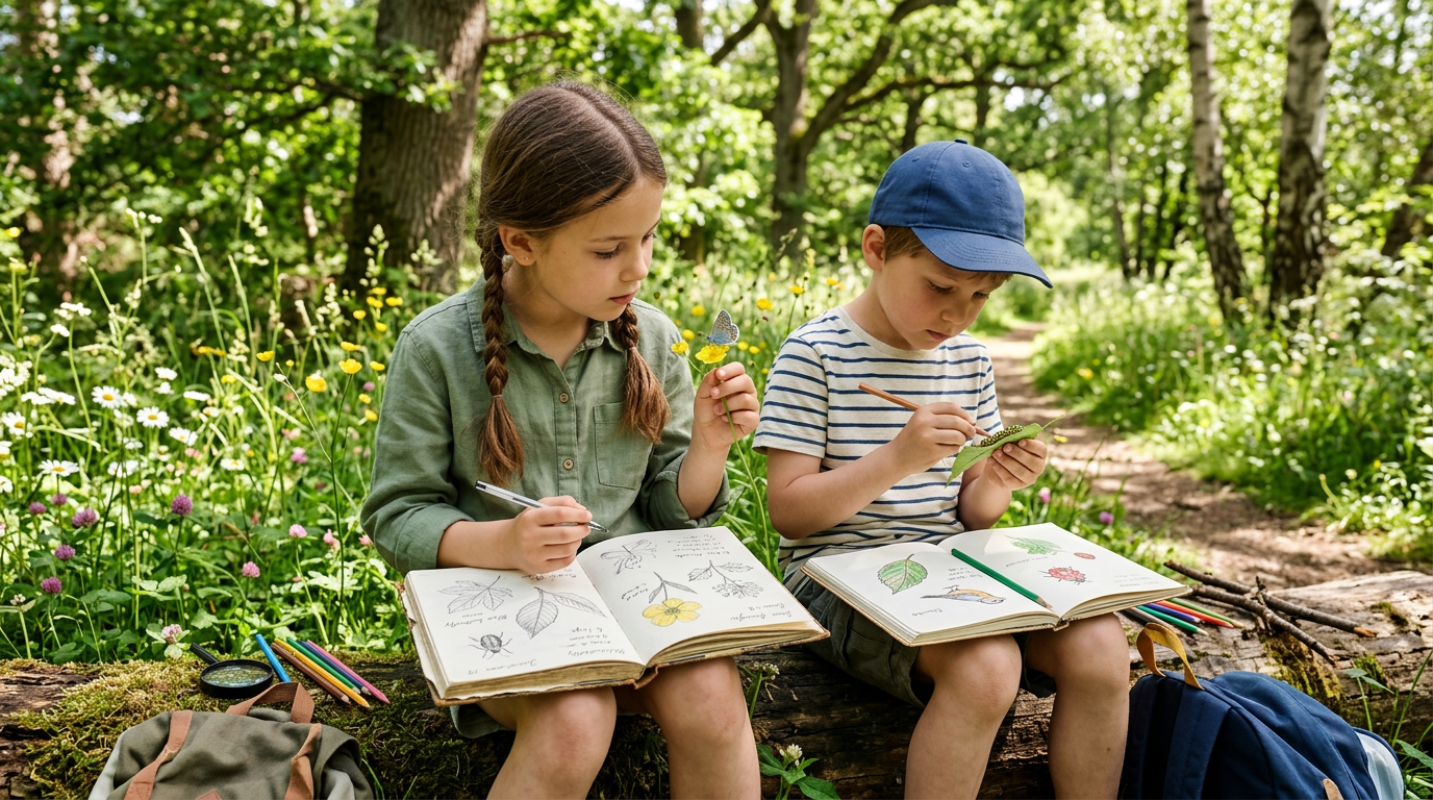
Start with a notebook that has thick, unlined paper. If you can find one with a waterproof cover, that is even better. For writing and drawing, a set of high-quality graphite pencils and a few fine-tip waterproof pens are the neededs. If your child wants to add color, a small set of watercolor pans or colored pencils works wonders. Avoid markers that bleed through the pages.
Establish a routine that feels like a treat rather than a chore. Maybe you head to the backyard every Saturday morning or visit a local trail after school on Wednesdays. Consistency builds the habit. On every page, encourage your child to record the "metadata" of their observation. This includes the date, the specific location, and the weather conditions. Is it breezy? Is the sun directly overhead? These details provide the context that turns a simple drawing into a scientific record.
The One Thing Close Up Challenge
One of the most effective ways to build visual acuity is to force the eye to focus on the micro rather than the macro. We call this the "One Thing Close-Up" challenge. Instead of trying to draw an entire garden, ask your child to find one single item. It could be a fallen leaf, a single petal from a daisy, or even a dead insect found on a windowsill.
The objective is to record every tiny detail. Does the leaf have jagged edges or smooth ones? Are there tiny hairs on the stem? This is where magnification tools become your best friend. A simple hand lens or a pocket microscope can reveal a hidden world of textures and structures that are invisible to the naked eye.
Expert educator Sarah Keel often suggests telling kids that they are not making art, they are collecting data. This simple shift in language lowers the pressure. If they feel like they have to draw a "pretty" flower, they might get frustrated. If they are told to "map the veins of this leaf," they focus on the task of observation. Using the "Zoom In, Zoom Out" method is particularly helpful here. Have them draw the specimen from five feet away, and then draw a one-inch section of it as seen through a magnifying glass.
Tracking Change Over Time
Nature is not a static photograph. It is a moving, breathing system. To help kids understand this, you need projects that focus on longitudinal observation. The "Adopt a Tree" project is a classic for a reason. Have your child pick one specific tree in your yard or a nearby park and commit to visiting it once a month for a full year.
During each visit, they should document the changes. They might notice the first tiny buds in spring, the deep greens of summer, the shriveling leaves of autumn, and the bare, stark branches of winter. This builds an understanding of growth cycles and seasonal shifts. It also encourages them to use more descriptive vocabulary. Instead of just saying a leaf is "brown," they might describe it as "brittle," "curled," or "spotted."
You can apply this to an anthill or a bird feeder. The key is to look for patterns. Do the birds come at the same time every day? Does the anthill get taller after it rains? This kind of systems thinking is a key part of the "I Notice, I Wonder, It Reminds Me Of" framework. When they see a change, they can ask "I wonder why this is happening?" and then make connections to things they already know.
Sensory Mapping and Soundscapes
To truly understand an environment, a child needs to use all of their senses. This project aims to use all the senses to record sounds, smells, and textures. A "Sound Map" is a fantastic way to sharpen auditory observation.
Have your child sit in one spot and draw a small "X" in the center of their journal page to represent themselves. For ten minutes, they should close their eyes and listen. Every time they hear a sound, they mark it on the map relative to where they are sitting. A bird chirping to the left might be represented by a small musical note. A car passing in the distance could be a series of lines.
You can also create sensory charts. Have them find five different textures in a small area. They can do a "rubbing" of a piece of bark or a stone by placing the paper over the object and rubbing a pencil across it. This records the physical texture of the world in a way a drawing cannot. Kate Rutter, an expert in the field, suggests using the "Four S's" to celebrate a place: Scenes, Senses, Spaces, and Souvenirs. This complete approach make sures that the journal becomes a complete record of an experience.
Top Recommendations for Nature Journaling Gear
To make these projects successful, having the right tools helps. Here are a few items that can improve the experience
- Field Notebooks: Look for journals with 120gsm paper to handle light watercolors without warping.
- Hand Lenses: A 10x magnification jeweler's loupe is perfect for the "One Thing Close-Up" challenge.
- Waterproof Pens: Fineliners that use archival ink won't smear if the page gets damp.
- Portable Sit Pads: A small, foldable foam pad makes it much more comfortable for kids to sit and observe for long periods.
- Nature Guides: Local bird or plant identification books help kids put names to the things they "Notice" and "Wonder" about.
Making Journaling a Lifelong Habit
The most important thing to remember is that you are building a relationship with the natural world, not a portfolio of art. If a page is messy, that is okay. If there are coffee stains or mud smudges, those are part of the story.
As a parent, the best thing you can do is journal alongside your child. Model the behavior. Let them hear you say, "I'm looking very carefully at how many petals this flower has," or "I wonder why the moss only grows on this side of the rock." This "thinking aloud" demonstrates what intentional observation looks like in practice.
In a world that is moving faster than ever, nature journaling is a way to hit the brakes. It teaches patience, rewards curiosity, and builds a deep connection to the environment. Whether you are in a dense forest or a small city balcony, there is always something to notice.
This article on strongstudy.com is for informational and educational purposes only. Readers are encouraged to consult qualified professionals and verify details with official sources before making decisions. This content does not constitute professional advice.