 (Image source: Gemini)
 Have you ever found yourself in the middle of a grocery store, staring at a four-year-old who is currently melting into the floor because you picked the blue box of crackers instead of the red one? It's a scene most parents know all too well. You feel the heat rising in your neck, the judgmental stares of other shoppers, and the desperate urge to just make it stop. But here is a perspective shift that might help the next time you're in the cereal aisle trenches. Your child isn't trying to give you a hard time. They're having a hard time. Emotional regulation is the ability to monitor and manage your energy states, emotions, thoughts, and behaviors in ways that are acceptable and produce positive results such as well-being, loving relationships, and learning. For a child under eight, this isn't an innate personality trait. It's a complex skill that has to be taught, practiced, and reinforced. Just like reading or riding a bike.
Why Emotional Regulation Matters Before Age Eight
The reason we focus so heavily on the years before age eight is simple biology. During this window, the brain is undergoing a massive construction project. The prefrontal cortex, which is the part of the brain responsible for impulse control and logical thinking, is still very much under development. In fact, it won't be fully finished until someone is in their mid-twenties.
When your child is under eight, they are operating with a high-powered emotional engine and very tiny, squeaky brakes. They feel things with an intensity that adults often forget. A broken crayon isn't just a minor inconvenience to a six-year-old. To them, it can feel like the end of the world.
Recent data shows that schools are taking this seriously. As of 2026, over 83% of K-12 principals report that their schools have adopted formal Social-Emotional Learning (SEL) curricula. When children can regulate their emotions, they can focus. When they can focus, they learn.
Foundation Building and Naming Feelings for Ages Two to Five
If you want to teach your child to manage their feelings, they first need to know what those feelings are. We often expect kids to "calm down" without giving them the vocabulary to describe why they're upset in the first place. This is where the phrase "name it to tame it" comes in.
When a child can put a label on an emotion, it shifts the activity in their brain from the emotional center (the amygdala) to the logical center (the prefrontal cortex). It's like turning on a light in a dark room. The monster is still there, but now you can see it's just a pile of laundry.
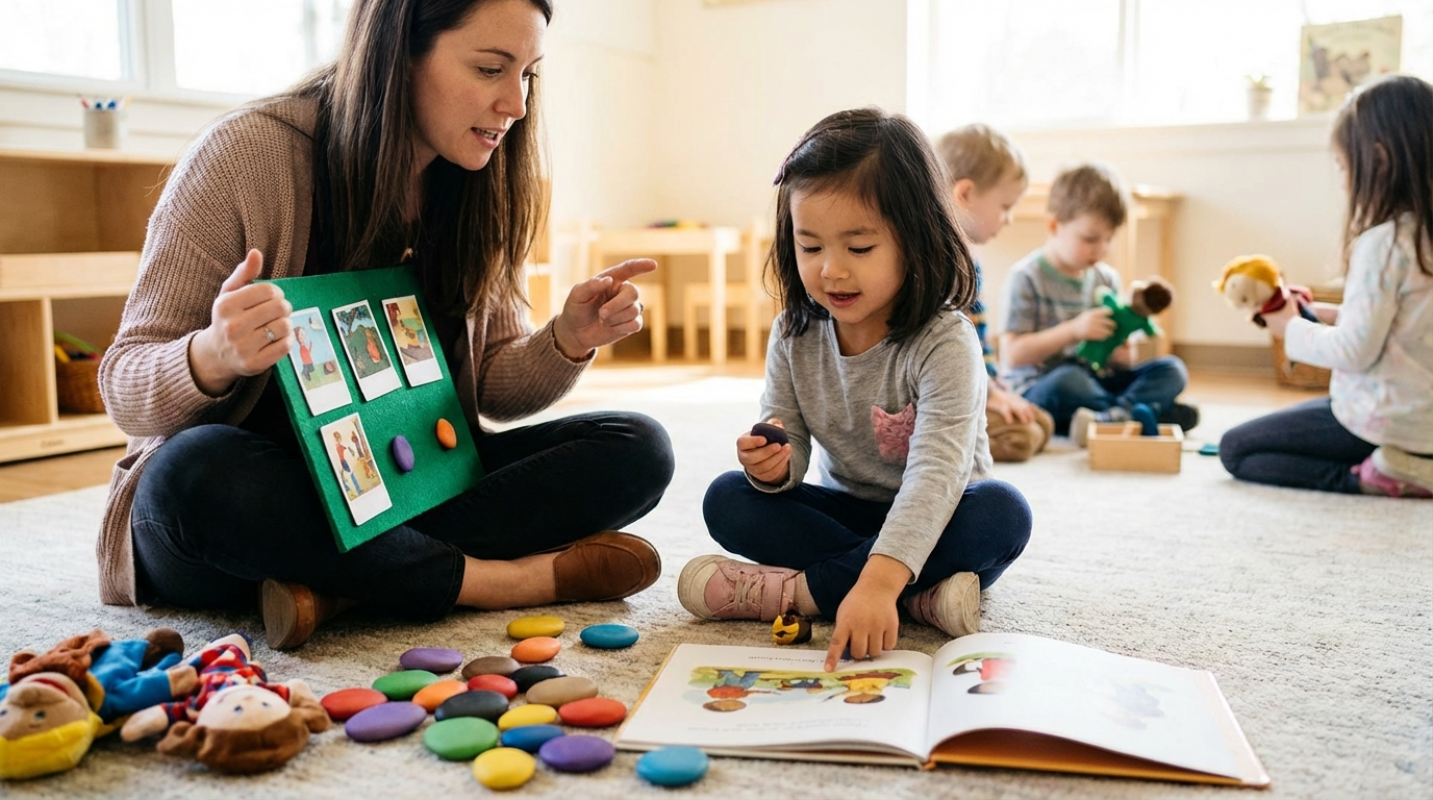
For toddlers and preschoolers, keep it simple, but don't stick to happy, sad, and mad. Use a variety of words. Are they frustrated? Disappointed? Lonely? Excited? You can use feeling charts with faces on them to help them point to what they're feeling. Validation is your most powerful tool here. You don't have to agree with their reaction to acknowledge their emotion.
Practical Tools and Simple Regulation Approaches
Once a child knows what they're feeling, they need to know what to do with that energy. "Don't be mad" doesn't work. Anger is a valid emotion. We need to give them a pause button.
Breathing techniques are the gold standard for a reason. They physically change the body's stress response. For kids under eight, abstract "deep breathing" is boring. You have to make it a game.
- Bunny Breath: Have your child take three quick sniffs through their nose (like a bunny sniffing a carrot) and one long exhale through their mouth.
- Balloon Breathing: Ask them to put their hands on their belly. Tell them to imagine their belly is a balloon. As they breathe in, the balloon gets big. As they breathe out, the balloon shrinks.
- Smell the Flower, Blow out the Candle: This is a classic. Pretend to smell a beautiful flower (deep inhale) and then blow out a birthday candle (slow exhale).
Another great tool is the "Cozy Spot." This is not a time-out chair. It's a designated area in your home filled with soft pillows, a few favorite books, or maybe a sensory jar. It's a place the child chooses to go when they feel their "body weather" turning stormy.
Movement is also a great regulator. Sometimes kids have too much big energy inside, and they need to get it out. Stomping like a dinosaur, shaking their arms like they're covered in water, or having a thirty-second dance party can reset their nervous system faster than a lecture ever will.
Parental Modeling as the Most Powerful Teaching Tool
Here is the truth that many of us don't want to hear: Your child is watching you. All the time. They are learning how to handle stress by observing how you handle the burnt toast, the traffic jam, or the lost keys. If you want your child to use their words when they're angry, you have to use yours. Narrate your own emotional process out loud.
What happens when you lose it? Because you will. We all do. This is the perfect time for repair. Go to your child after you've calmed down and apologize. "I'm sorry I raised my voice earlier. I was feeling overwhelmed, but it wasn't okay for me to yell. Next time, I'll try to take a break first."
Moving Towards Independence and Problem Solving for Ages Six to Eight
As children move toward the seven and eight-year-old mark, they start to develop more cognitive muscle. This is when you can move from co-regulation to collaborative problem-solving.
Instead of telling them what to do, ask them. "I see you're frustrated with this math homework. What's one thing we could do to make it feel a little easier? Do you need a five-minute break or a snack?"
This is also the age to introduce the power of "yet." This is a simple form of cognitive reframing. If your child says, "I can't do this," you add, "You can't do this yet." It changes the brain's perspective from a dead-end to a path forward.
Research from 2025 suggests that these early interventions lead to significant gains. Children who receive explicit instruction in these areas see an average 4 to 11 percentile point increase in academic achievement. You're building a brain that is ready to work.
Top Recommendations for Emotional Growth
Helping your child handle their internal world doesn't have to be a chore. There are many modern tools that make this process interactive and even fun.
- The Zones of Regulation: This is a framework that uses colors to help kids identify their energy levels. Green is good to go, yellow is "slow down," red is "stop and reset," and blue is "low energy."
- Gamified Regulation Apps: Tools like Mightier use heart rate monitors to help kids stay calm while playing video games. It's literal exercise for their "emotional brakes."
- Sensory Grounding Kits: Keeping a small box with items of different textures, smells, and sights can help a child ground themselves when they feel overwhelmed.
Teaching these lessons is a marathon, not a sprint. There will be days where it feels like you're making no progress at all. But every time you validate a feeling, every time you take a deep breath together, and every time you apologize for losing your cool, you're laying a brick in the foundation of their future mental health.
This article on strongstudy.com is for informational and educational purposes only. Readers are encouraged to consult qualified professionals and verify details with official sources before making decisions. This content does not constitute professional advice.