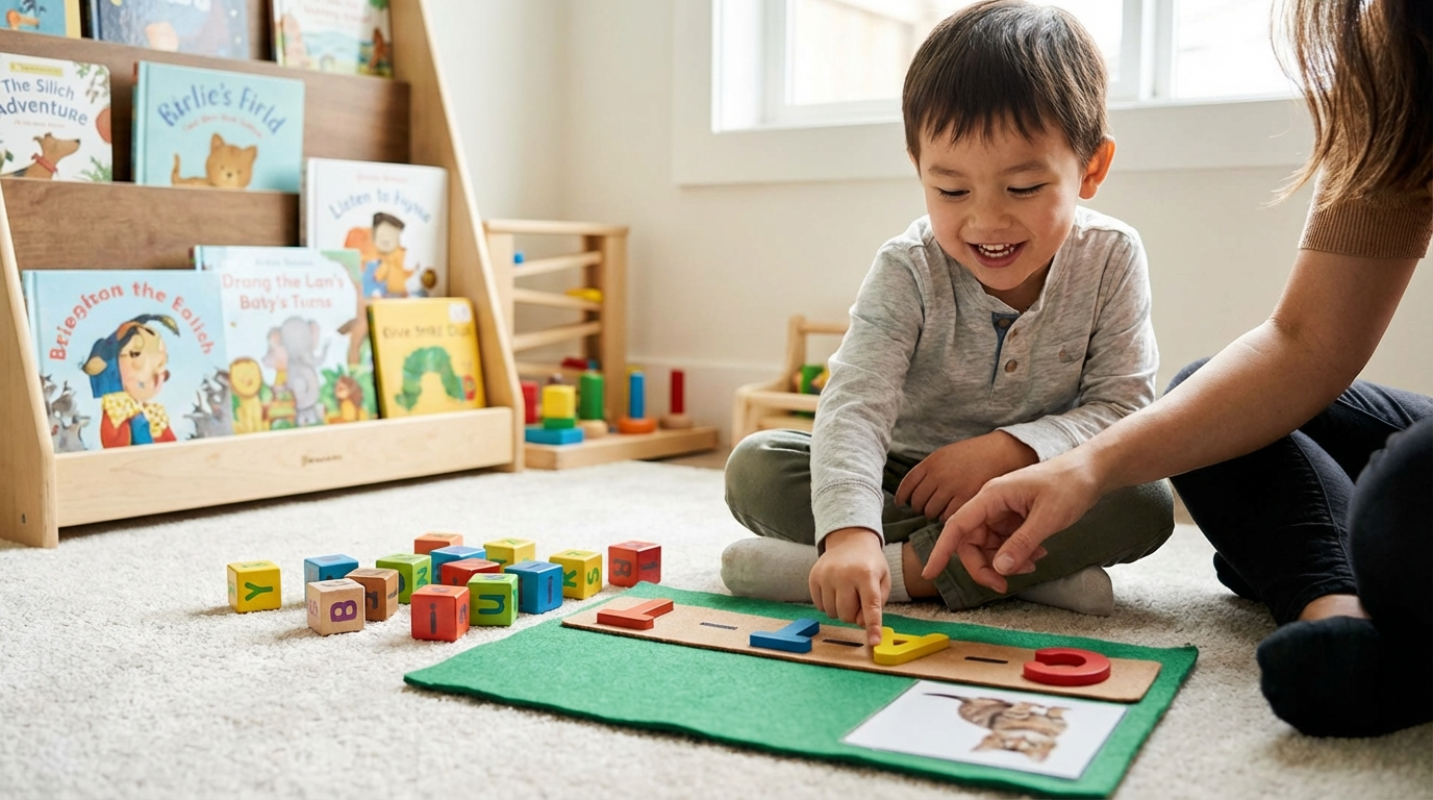
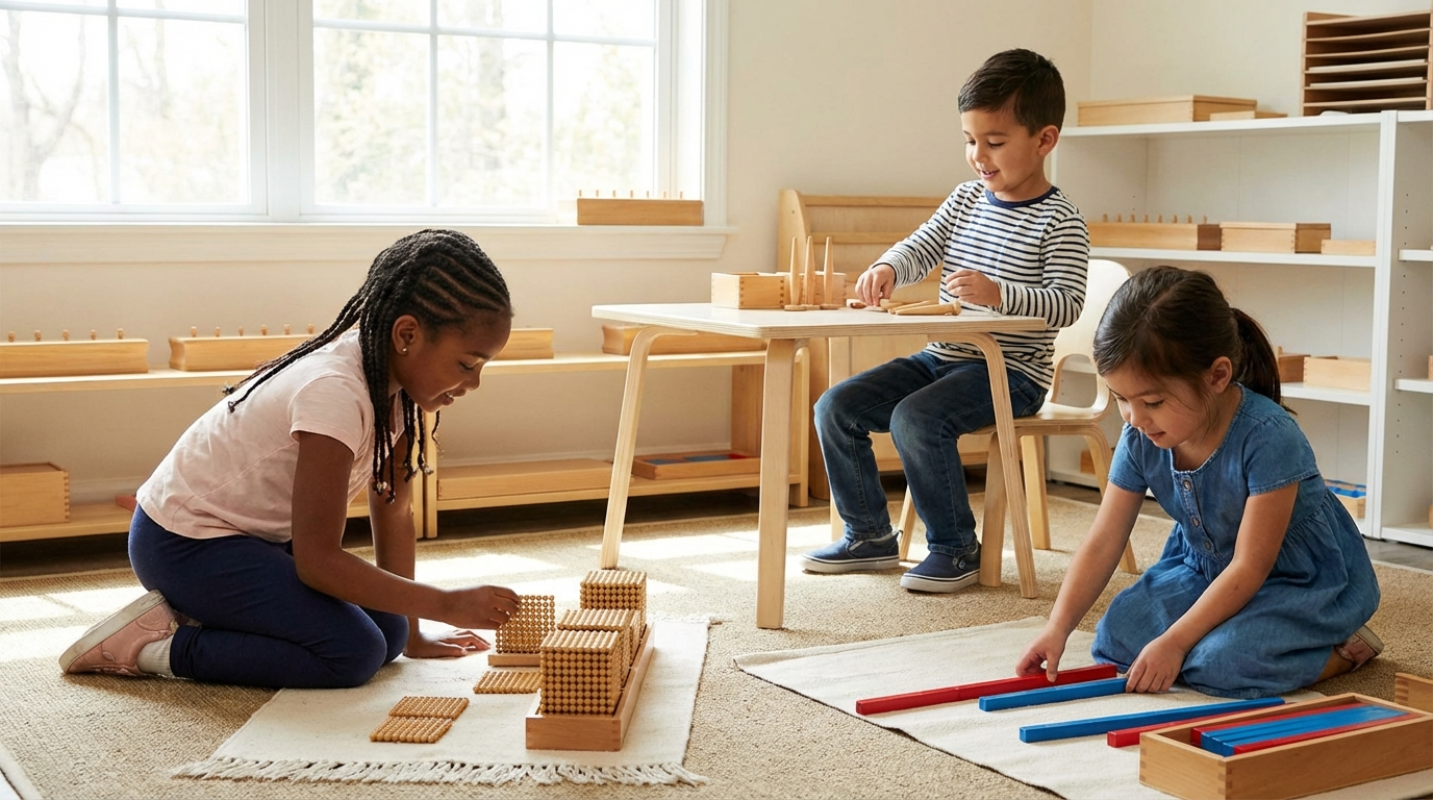
 (Image source: Gemini)
 Have you ever watched a five-year-old try to grasp the concept of one thousand? In a traditional classroom, it's a big number on a worksheet. But in a Montessori environment, that child is likely lugging around a heavy wooden cube made of ten hundred-squares. They're feeling the weight of a thousand. This is the core of the Montessori math philosophy. Between the ages of four and six, children enter what Maria Montessori called a sensitive period for numbers and order. They have a natural, almost obsessive interest in counting and exactness. If you've ever had a four-year-old insist on counting every single stair in a flight or every blueberry in their bowl, you've seen this in action.
The goal during these years is to move from the concrete to the abstract, not memorization. We want children to manipulate physical objects until the mathematical concepts are literally etched into their minds. Recent research from early 2025, including a landmark PNAS study involving 3,000 children, confirmed that this hands-on approach leads to significantly higher math scores and better executive function by age six compared to traditional methods.
So how do we actually do it? Let's look at the specific activities that turn a "math hater" into a "math lover" before they even hit first grade.
The Concrete Foundation of Quantity and Sequence
Before a child can solve an equation, they need to understand what a number actually represents. We start with the physical quantity. You've probably seen the Number Rods in a classroom. These are ten wooden rods, alternating red and blue, ranging from ten centimeters to one meter.
When a child carries the "ten" rod, they feel how long and heavy it is compared to the "one" rod. They're learning a name and internalizing the physical space a quantity occupies. Once they have the feel for the rods, we introduce Sandpaper Numbers. These are tactile numerals that the child traces with their fingers while saying the name. It connects the symbol, the sound, and the physical movement of writing.
Then comes the Spindle Boxes. This is a personal favorite because it's the first time a child encounters the concept of zero. The child is given forty-five loose spindles and must place the correct amount into slots labeled zero through nine. When they get to the "zero" slot, they realize their hands stay empty. There's nothing to put in. That's a huge "aha" moment for a five year old.
Always follow the "see it, touch it, name it" progression. Don't show a child a written "5" until they've held five objects in their hands. This builds a foundation that prevents the "math anxiety" we see so often in older kids.
Moving Beyond Single Digits
Once a child masters one through ten, we don't jump to eleven. We go big. We introduce the Decimal System using the Golden Beads. This is the cornerstone of Montessori math.
In this activity, a single bead is a unit. Ten beads wired together is a ten-bar. Ten bars clicked together is a hundred-square. Ten squares stacked up is a thousand-cube. You'll often see five year olds playing the "Bring Me" game. You might ask, "Can you bring me three thousands, two hundreds, four tens, and seven units?"
The child walks across the room, gathers the physical weight of that number, and brings it back. They are developing a deep, intuitive sense of place value. They are seeing the volume of the number.
By age five, many Montessori students are performing four-digit addition. It sounds advanced, but it's actually quite simple when you're combining piles of beads and then "exchanging" ten units for a ten-bar. This is where the 2025 research on cost-effectiveness really shines. Public Montessori programs often save districts over $13,000 per child because these mixed-age classrooms allow children to learn through peer observation and self-correcting materials, reducing the need for constant one-on-one teacher intervention.
A common pitfall here is rushing to the paper and pencil. If a child struggles with the "teen boards" (which teach that eleven is ten and one, twelve is ten and two), it usually means they need more time with the beads. Let them stay in the concrete phase as long as they need. Mastery is better than speed.
Top Recommendations
Early Operations
As the child nears age six, we start the bridge to abstraction. This is where the Stamp Game comes in. Think of it as the digital version of the Golden Beads. Instead of beads that vary in size and weight, the child uses small, identical wooden tiles (stamps).
Each stamp is the same size, but they're color-coded: green for units, blue for tens, red for hundreds, and green again for thousands. Now, the child has to rely on the symbol and the color to know the value, not the physical bulk. It's a massive step toward mental math.
When we teach addition with the Stamp Game, the child literally pushes two groups of stamps together. For subtraction, they physically take the stamps away and put them back in the box. When they need to "carry over" or "borrow," they perform an exchange. They take ten "ten" stamps to the "bank" and trade them for one "hundred" stamp.
You don't need to use complex jargon like "regrouping." Talk about it as an exchange. "We have ten of these, so let's trade them for one of those." It makes sense to a child's logical mind.
In 2024 and 2025, the American Montessori Society has also emphasized "Social Math." Instead of working alone, children are encouraged to solve these "big" problems in pairs. One child might be the "banker" while the other sets up the problem. This builds mathematical language and reasoning skills that go beyond just getting the right answer.
Building a Lifetime of Mathematical Confidence
The beauty of these activities is that they are almost all self-correcting. If a child is using the Spindle Boxes and has one spindle left over at the end, they know they made a mistake somewhere. They don't need a teacher to put a red "X" on their paper. They can go back and find the error themselves.
This builds a sense of autonomy and confidence. Math isn't something that a teacher "gives" to them. It's something they discover and control. As a parent or educator, your role is to prepare the environment and then step back. Resist the urge to jump in and "fix" their mistakes. Observation is your best tool.
If you want to start this week, don't feel like you need to buy a thousand dollars' worth of wooden equipment. You can start with simple one-to-one correspondence games using items from your junk drawer or beans from the pantry. The goal is to make math a physical, tactile part of their daily life.
Montessori math doesn't rely on rote memorization because it doesn't have to. When a child has spent two years physically building numbers, the "abstract" math they encounter later in life isn't scary. It's a shorthand for the beads and stamps they've known since they were four.
This article on strongstudy.com is for informational and educational purposes only. Readers are encouraged to consult qualified professionals and verify details with official sources before making decisions. This content does not constitute professional advice.