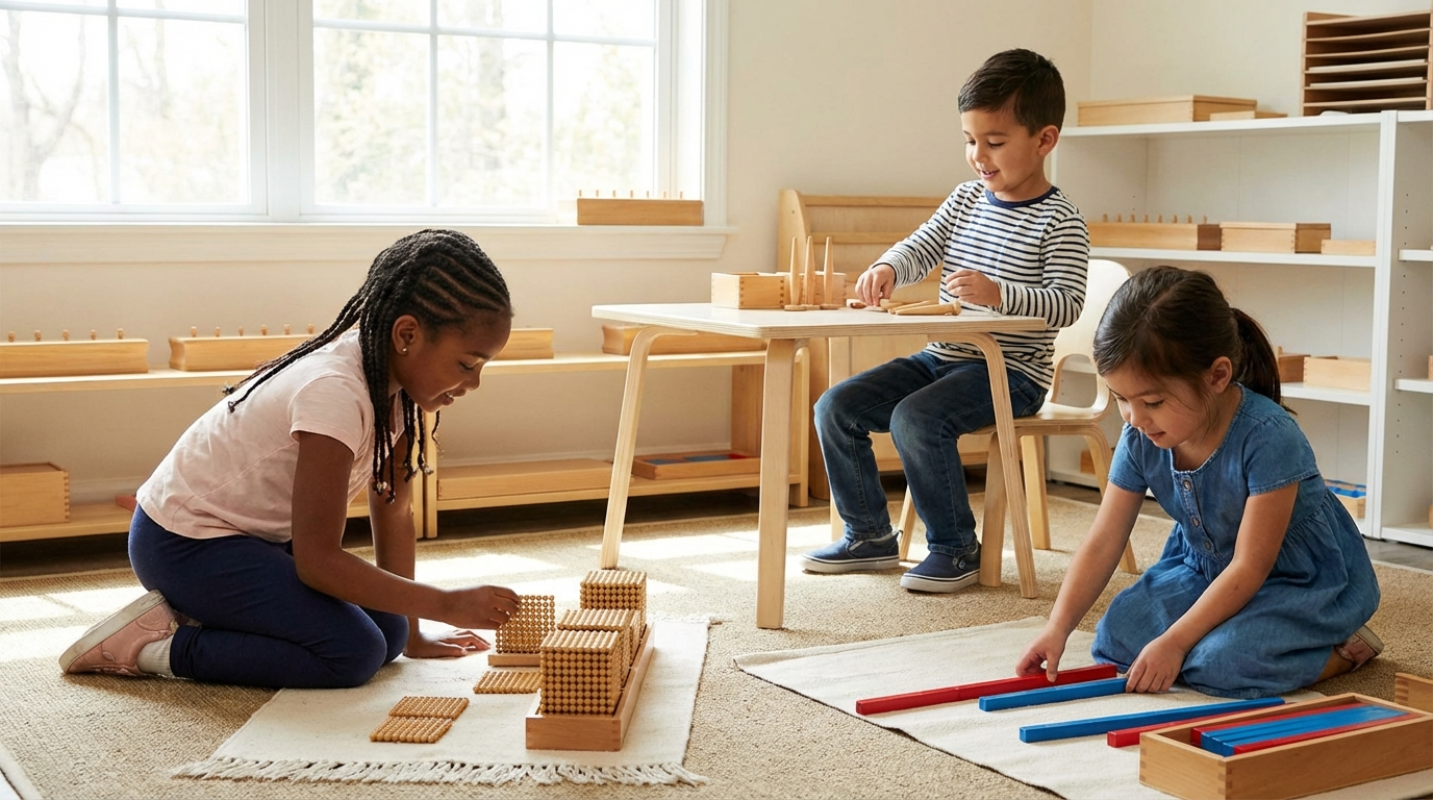
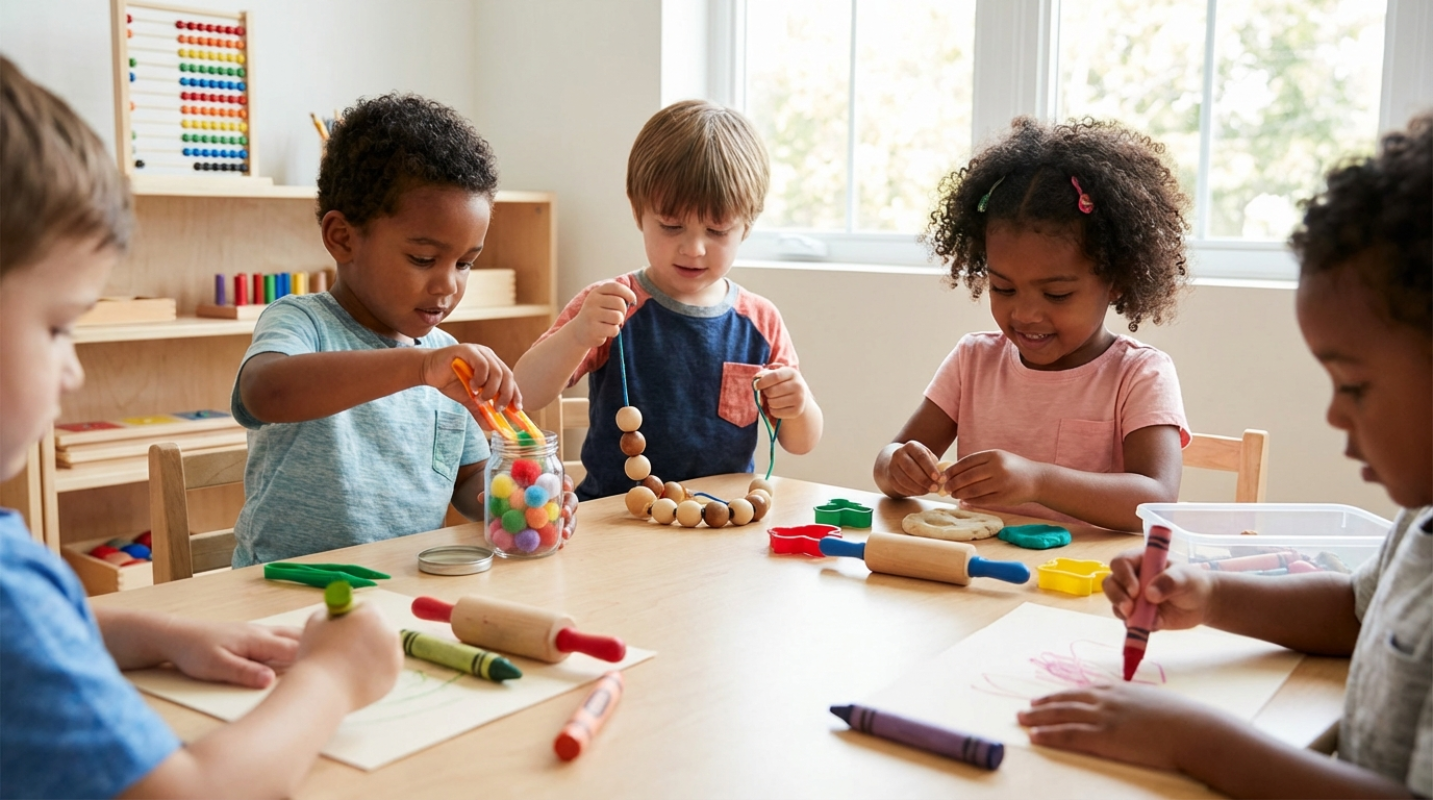
 (Image source: Gemini)
 Have you ever watched a four-year-old try to wrestle a jumbo crayon into submission? It looks like a tiny, high-stakes battle. We often think of handwriting as a mental task, something involving the brain learning the alphabet and the eyes recognizing shapes. But in reality, it is a physical feat. It requires a level of coordination and strength that most adults take for granted. If the hand muscles aren't ready, the brain's best intentions won't matter much on the page. Fine motor skills (FMS) are the movements involving the small muscles in the hands and wrists. They are the direct precursors to a functional pencil grip and legible letter formation. Pediatric experts agree that we cannot rush the pencil. Recent data has shown that fine motor precision accounts for roughly 60% of the variance in handwriting legibility for kids in preschool. If a child struggles to hold a fork or button a shirt, they will likely struggle to form the letter "A" when the time comes.
This is why we focus on the developmental stages leading up to handwriting, typically occurring between ages three and seven. It is a journey that starts with big, messy movements and slowly refines into the delicate dance of the tripod grasp. If you are a parent or an educator, your goal isn't to force a child to write lines of letters for hours. It's to build the "engine" that makes writing possible.
The Foundation of Hand Strength and Dexterity
Think of your child's hand like a tiny athlete. Before an athlete can compete, they need a solid strength-training program. For a child, this means focusing on the intrinsic hand muscles. These are the small muscles located entirely within the hand that allow for precise finger movements. Without enough strength here, a child will experience hand fatigue, leading to frustration and a quick "I'm done!" during writing sessions.
One of the best ways to build this strength is through resistance training disguised as play. You don't need fancy equipment, just a few household staples.
- Play-Doh and Putty Sculpting: This is the gold standard for hand gyms. Encourage your child to roll "snakes," pinch off tiny "blueberries," or hide small beads inside a ball of putty for them to find. This "Hide and Seek" game forces the fingers to work against resistance, which builds endurance.
- Squeezing and Squishing: Give your child a spray bottle to water plants or a sponge to squeeze out while washing plastic dishes. The repetitive squeezing motion is fantastic for the palm and thumb muscles.
- Clothespin Power: Using clothespins or tongs to move objects from one bowl to another is a classic for a reason. It targets the "web space" between the thumb and index finger, which is the exact area that needs to be open and strong for a good pencil grip.
The key here is resistance. If an activity is too easy, it isn't building muscle. You want to see those little fingers working hard, but not so hard that they give up.
Precision and Bilateral Coordination for Two-Handed Tasks
Handwriting is rarely a one-handed job. Although one hand is busy understanding the pencil, the other hand must stabilize the paper. This is called bilateral coordination, and it's a major milestone in child development. If a child's "helper hand" hangs out in their lap while they try to draw, the paper will slide around, and the result will be a mess.
Bilateral coordination involves "crossing the midline." This is the imaginary line down the center of the body. Being able to reach across that line with the right hand to pick something up on the left side is needed for the brain's left and right hemispheres to communicate. This communication is what eventually allows for smooth, fluid writing across a page.
- The Art of Tearing: Instead of reaching for the scissors right away, let your child tear construction paper into small bits to make a mosaic. Tearing requires both hands to move in opposite directions simultaneously, which is a sophisticated motor task.
- Bead Stringing: Use large wooden beads and a stiff lace. One hand holds the string while the other maneuvers the bead. This forces the eyes and hands to work together in a tight, controlled space.
- Scissor Skills: Start simple. Let them snip play-dough or "fringe" the edge of a piece of paper. As they get better, move to straight lines, then curves, and finally complex shapes. Cutting is one of the most intense bilateral tasks a child can do.
Pre-Writing Strokes and Visual-Motor Integration
Before a child can write a letter, they need to be able to draw the components of that letter. Most letters are a combination of vertical lines, horizontal lines, circles, and slants. We call these pre-writing strokes. If a child can't comfortably draw a cross or a square, they aren't quite ready for the alphabet.
We also want to move from gross motor movements (big arm swings) to fine motor movements (wrist and finger control). A great way to do this is by changing the "canvas."
- Vertical Surfaces: Tape a piece of paper to the wall or let them draw on a window with dry-erase markers. Working on a vertical surface naturally puts the wrist into an extended position. This is the best position for writing. It also builds shoulder stability, which provides the "anchor" for the hand to move.
- Sensory Trays: Fill a shallow tray with salt, sand, or even shaving cream. Let your child "draw" shapes with their index finger. This provides tactile feedback that paper and pencil can't match. It helps the brain "map" the movement of the stroke through touch.
- Rainbow Writing: This is a favorite in many classrooms. Have your child draw a large shape or letter, then trace over it five or ten times using a different colored crayon each time. This repetition builds muscle memory without the boredom of traditional worksheets.
Mastering the Tripod Grip and Pencil Control
Eventually, the time comes to pick up the tool. Most children start with a fisted grip, using their whole hand to move the crayon. This is normal! But as they develop, we want to move them toward the dynamic tripod grasp, where the pencil is held between the thumb and index finger, resting on the middle finger.
If you see your child struggling with a long, heavy pencil, it might be because the tool is too big for their hand. Think of it like trying to write with a broomstick.
- The Short Tool Approach: Use broken crayons or golf pencils. Because these tools are short, there isn't enough room for a child to wrap their whole fist around them. They are almost forced to use their fingertips, which naturally encourages a tripod grip.
- Sticker Placement: Give your child a sheet of small stickers and a line drawn on a piece of paper. Ask them to place the stickers exactly on the line. Peeling the stickers off the sheet is a fantastic pincer grasp exercise, and placing them accurately builds visual-motor control.
- Visual Cues: If they keep forgetting where their fingers go, you can place a small rubber band around the bottom of the pencil or use a specialized grip. But don't rely on these forever. The goal is for the muscles to do the work, not the plastic aid.
Making Practice a Natural Part of the Day
It's easy to get caught up in the idea of "lessons," but the best fine motor practice happens when you aren't even trying. Consistency is far more important than intensity. You don't need a grueling hour of "hand gym" every Saturday. You need five minutes of "purposeful play" every day.
Integrate these skills into your daily routine. Let your child help you in the kitchen by tearing lettuce for a salad or using a melon baller. Encourage them to dress themselves, focusing on those tricky buttons and zippers. Even picking up small pieces of cereal one by one is a win for the pincer grasp.
Handwriting readiness is a journey, not a race. Every time your child pinches, pulls, squeezes, or tears, they are laying the groundwork for the day they finally sit down and write their name with ease. Keep it fun, keep it messy, and remember that the "unsung heroes" of handwriting are the tiny muscles that are getting stronger every single day.
This article on strongstudy.com is for informational and educational purposes only. Readers are encouraged to consult qualified professionals and verify details with official sources before making decisions. This content does not constitute professional advice.